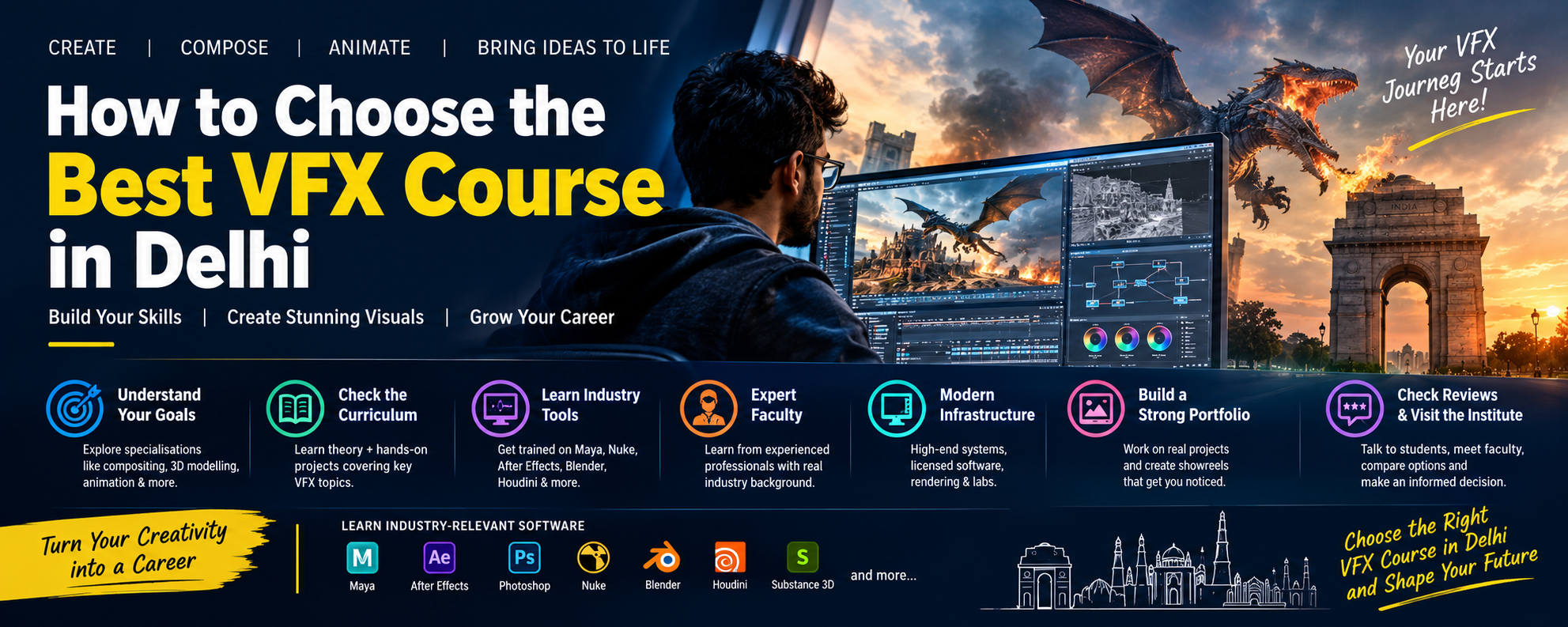
How to Choose the Best VFX Course in Delhi
Visual effects (VFX) have become an important part of modern filmmaking, television, advertising, gaming, animation, and digital content. From creating realistic environments to designing spectacular action sequences, VFX professionals help turn creative ideas into engaging visual experiences. With the growing demand for skilled VFX artists, many students and aspiring professionals are looking for the right VFX course in Delhi to start or advance their careers.
However, choosing the right institute and course can be challenging because Delhi has numerous training centres offering different programs, durations, fees, software, and career support. Before enrolling, it is important to carefully evaluate what a course offers and whether it matches your career goals.
Here are some important factors to consider when choosing the best VFX course in Delhi.
1. Understand Your Career Goals VFX Course in Delhi
Before comparing institutes, decide what you want to achieve from your VFX education. VFX is a broad field with several specialisations, including compositing, 3D modelling, texturing, lighting, animation, motion graphics, rotoscoping, matchmoving, and visual effects design.
If you are interested in creating digital environments, you may want to explore 3D modelling and environment design. If you enjoy combining live-action footage with computer-generated elements, compositing could be a suitable career path.
Having a clear goal will help you select a VFX course in Delhi that provides relevant training instead of choosing a course simply because it is popular.
2. Check the Curriculum VFX Course in Delhi
A strong curriculum is one of the most important factors when selecting a VFX course. Carefully review the subjects and modules covered by the program.
A comprehensive course may include topics such as:
- Fundamentals of VFX
- 2D and 3D compositing
- 3D modelling
- Texturing and shading
- Lighting and rendering
- Rotoscopy
- Matchmoving
- Motion graphics
- 3D animation
- Green-screen techniques
- Camera tracking
- Visual effects production
- Project development
The curriculum should combine theoretical concepts with practical assignments. VFX is a skill-oriented industry, so simply learning definitions and tools is not enough. Students need opportunities to apply their knowledge to realistic projects.
3. Look at the Software and Tools Being Taught VFX Course in Delhi
Professional VFX production involves various software applications. When comparing a VFX course in Delhi, check whether the institute teaches industry-relevant tools.
Depending on the specialisation, software may include applications such as Autodesk Maya, Adobe After Effects, Adobe Photoshop, Nuke, Blender, Houdini, Substance 3D tools, and other specialised programs.
You should not choose a course solely because it offers a long list of software. Instead, check whether the course teaches the tools properly and explains how they are used in an actual production workflow.
Learning fewer tools thoroughly can be more useful than learning many applications only at a basic level.
4.Evaluate the Faculty and Trainers VFX Course in Delhi
Experienced trainers can make a significant difference to your learning experience. Before enrolling, research the faculty members and their professional backgrounds.
Look for trainers who have practical experience in areas such as film production, advertising, animation, gaming, post-production, or visual effects. Industry experience can help students understand how VFX projects are developed in professional environments.
You can also attend a demo class, if available, to understand the teaching approach. A good trainer should be able to explain complex concepts clearly and provide constructive feedback on student projects.
5.Check the Institute’s Infrastructure VFX Course in Delhi
VFX training requires appropriate hardware and software. Before joining a course, visit the institute and check its facilities.
Pay attention to factors such as:
- Computer specifications
- Graphics processing capabilities
- Availability of licensed software
- Classroom environment
- Rendering facilities
- Internet connectivity
- Practice lab availability
- Access to equipment outside regular classes
VFX applications can require significant computing power, particularly when students work with high-resolution 3D scenes, simulations, animation, and compositing. Proper infrastructure can therefore contribute to a smoother learning experience.
6. Review Student Projects and Showreels VFX Course in Delhi
One of the easiest ways to understand the practical quality of a VFX program is to review previous students’ work.
Ask the institute to show student showreels, short films, compositing exercises, 3D projects, animation work, or other relevant assignments. Look for evidence that students are actually creating original projects rather than simply completing basic software exercises.
A strong portfolio is particularly important because employers and clients often want to see what a candidate can create. Therefore, choose a VFX course in Delhi that gives you enough opportunities to develop portfolio-quality work.
7. Consider Course Duration and Learning Format VFX Course in Delhi
VFX programs are available in different formats, including short-term courses, certificate programs, diploma programs, and longer-term professional programs.
Consider how much time you can realistically dedicate to learning. A short course may be suitable for someone who wants to learn a specific skill, while a comprehensive program may be more appropriate for beginners who want broader training.
Also check whether classes are conducted offline, online, or through a hybrid format. For beginners, practical classroom training can provide opportunities to receive immediate guidance and feedback.
8. Compare Course Fees and What They Include VFX Course in Delhi
Course fees can vary considerably between institutes. However, the cheapest course is not necessarily the most suitable option.
Instead of comparing prices alone, find out what is included in the fee. Ask whether the fee covers software access, practical lab sessions, projects, study material, assessments, portfolio development, and other services.
It is also useful to ask about payment schedules and whether there are additional charges for examinations, certification, software, or other facilities.
The goal should be to understand the overall value of the program rather than choosing a course based solely on its advertised price.
9. Investigate Placement and Career Support VFX Course in Delhi
Career support can be an important consideration, especially for students who want to enter the VFX industry after completing their course.
When researching a VFX course in Delhi, ask the institute for clear information about its placement assistance. Find out what type of support is provided, such as resume preparation, interview training, portfolio development, internship opportunities, industry interactions, or job referrals.
Be cautious about vague placement claims. Ask for specific information about the type of companies that recruit students, the roles available, and how the placement process works.
10. Check Reviews and Student Feedback VFX Course in Delhi
Online reviews can provide useful insights into an institute’s teaching quality, facilities, administration, and student experience. However, do not rely on a single review or rating.
Look at feedback from multiple sources and pay attention to recurring comments. You can also speak directly with current or former students if possible.
Ask them about the quality of teaching, practical training, faculty support, assignments, infrastructure, and career guidance. First-hand experiences can help you understand what the course is actually like.
11.Ask About Portfolio Development VFX Course in Delhi
A certificate alone may not be enough to demonstrate your VFX abilities to potential employers. Your portfolio and showreel can play an important role when applying for entry-level creative positions.
Therefore, select a course that includes substantial project work. Ideally, you should finish the program with several well-executed projects demonstrating your technical and creative skills.
A good portfolio can showcase areas such as 3D modelling, compositing, animation, motion graphics, or other specialisations depending on your career objective.
12.Visit the Institute Before Enrolling VFX Course in Delhi
Finally, if possible, visit the institute personally before making a decision. Talk to the counsellor, meet the trainers, inspect the classrooms and labs, and ask detailed questions about the course.
Prepare a list of questions beforehand. Ask about class size, practical sessions, software, projects, faculty experience, assessments, certification, and career support.
Taking time to compare multiple institutes can help you make a more informed decision.
Conclusion
Choosing the right VFX course in Delhi requires more than comparing course fees or selecting an institute based on advertisements. You should consider your career goals, curriculum, software training, faculty experience, infrastructure, practical projects, portfolio development, course duration, and career support.
VFX is a practical and competitive field, so hands-on learning should be a major priority. Take the time to research different programs, review student work, visit institutes, and ask detailed questions before enrolling.
The right course should help you build both technical knowledge and creative problem-solving skills. With structured training, consistent practice, and a strong portfolio, you can develop the skills needed to explore opportunities in film, television, advertising, animation, gaming, and other digital media industries.Visual effects (VFX) have become an important part of modern filmmaking, television, advertising, gaming, animation, and digital content. From creating realistic environments to designing spectacular action sequences, VFX professionals help turn creative ideas into engaging visual experiences. With the growing demand for skilled VFX artists, many students and aspiring professionals are looking for the right VFX course in Delhi to start or advance their careers.
However, choosing the right institute and course can be challenging because Delhi has numerous training centres offering different programs, durations, fees, software, and career support. Before enrolling, it is important to carefully evaluate what a course offers and whether it matches your career goals.
Here are some important factors to consider when choosing the best VFX course in Delhi.
1. Understand Your Career Goals
Before comparing institutes, decide what you want to achieve from your VFX education. VFX is a broad field with several specialisations, including compositing, 3D modelling, texturing, lighting, animation, motion graphics, rotoscoping, matchmoving, and visual effects design.
If you are interested in creating digital environments, you may want to explore 3D modelling and environment design. If you enjoy combining live-action footage with computer-generated elements, compositing could be a suitable career path.
Having a clear goal will help you select a VFX course in Delhi that provides relevant training instead of choosing a course simply because it is popular.
2. Check the Course Curriculum
A strong curriculum is one of the most important factors when selecting a VFX course. Carefully review the subjects and modules covered by the program.
A comprehensive course may include topics such as:
- Fundamentals of VFX
- 2D and 3D compositing
- 3D modelling
- Texturing and shading
- Lighting and rendering
- Rotoscopy
- Matchmoving
- Motion graphics
- 3D animation
- Green-screen techniques
- Camera tracking
- Visual effects production
- Project development
The curriculum should combine theoretical concepts with practical assignments. VFX is a skill-oriented industry, so simply learning definitions and tools is not enough. Students need opportunities to apply their knowledge to realistic projects.
3. Look at the Software and Tools Being Taught
Professional VFX production involves various software applications. When comparing a VFX course in Delhi, check whether the institute teaches industry-relevant tools.
Depending on the specialisation, software may include applications such as Autodesk Maya, Adobe After Effects, Adobe Photoshop, Nuke, Blender, Houdini, Substance 3D tools, and other specialised programs.
You should not choose a course solely because it offers a long list of software. Instead, check whether the course teaches the tools properly and explains how they are used in an actual production workflow.
Learning fewer tools thoroughly can be more useful than learning many applications only at a basic level.
4. Evaluate the Faculty and Trainers
Experienced trainers can make a significant difference to your learning experience. Before enrolling, research the faculty members and their professional backgrounds.
Look for trainers who have practical experience in areas such as film production, advertising, animation, gaming, post-production, or visual effects. Industry experience can help students understand how VFX projects are developed in professional environments.
You can also attend a demo class, if available, to understand the teaching approach. A good trainer should be able to explain complex concepts clearly and provide constructive feedback on student projects.
5. Check the Institute’s Infrastructure
VFX training requires appropriate hardware and software. Before joining a course, visit the institute and check its facilities.
Pay attention to factors such as:
- Computer specifications
- Graphics processing capabilities
- Availability of licensed software
- Classroom environment
- Rendering facilities
- Internet connectivity
- Practice lab availability
- Access to equipment outside regular classes
VFX applications can require significant computing power, particularly when students work with high-resolution 3D scenes, simulations, animation, and compositing. Proper infrastructure can therefore contribute to a smoother learning experience.
6. Review Student Projects and Showreels
One of the easiest ways to understand the practical quality of a VFX program is to review previous students’ work.
Ask the institute to show student showreels, short films, compositing exercises, 3D projects, animation work, or other relevant assignments. Look for evidence that students are actually creating original projects rather than simply completing basic software exercises.
A strong portfolio is particularly important because employers and clients often want to see what a candidate can create. Therefore, choose a VFX course in Delhi that gives you enough opportunities to develop portfolio-quality work.
7. Consider Course Duration and Learning Format
VFX programs are available in different formats, including short-term courses, certificate programs, diploma programs, and longer-term professional programs.
Consider how much time you can realistically dedicate to learning. A short course may be suitable for someone who wants to learn a specific skill, while a comprehensive program may be more appropriate for beginners who want broader training.
Also check whether classes are conducted offline, online, or through a hybrid format. For beginners, practical classroom training can provide opportunities to receive immediate guidance and feedback.
8. Compare Course Fees and What They Include
Course fees can vary considerably between institutes. However, the cheapest course is not necessarily the most suitable option.
Instead of comparing prices alone, find out what is included in the fee. Ask whether the fee covers software access, practical lab sessions, projects, study material, assessments, portfolio development, and other services.
It is also useful to ask about payment schedules and whether there are additional charges for examinations, certification, software, or other facilities.
The goal should be to understand the overall value of the program rather than choosing a course based solely on its advertised price.
9. Investigate Placement and Career Support
Career support can be an important consideration, especially for students who want to enter the VFX industry after completing their course.
When researching a VFX course in Delhi, ask the institute for clear information about its placement assistance. Find out what type of support is provided, such as resume preparation, interview training, portfolio development, internship opportunities, industry interactions, or job referrals.
Be cautious about vague placement claims. Ask for specific information about the type of companies that recruit students, the roles available, and how the placement process works.
10. Check Reviews and Student Feedback
Online reviews can provide useful insights into an institute’s teaching quality, facilities, administration, and student experience. However, do not rely on a single review or rating.
Look at feedback from multiple sources and pay attention to recurring comments. You can also speak directly with current or former students if possible.
Ask them about the quality of teaching, practical training, faculty support, assignments, infrastructure, and career guidance. First-hand experiences can help you understand what the course is actually like.
11. Ask About Portfolio Development
A certificate alone may not be enough to demonstrate your VFX abilities to potential employers. Your portfolio and showreel can play an important role when applying for entry-level creative positions.
Therefore, select a course that includes substantial project work. Ideally, you should finish the program with several well-executed projects demonstrating your technical and creative skills.
A good portfolio can showcase areas such as 3D modelling, compositing, animation, motion graphics, or other specialisations depending on your career objective.
12. Visit the Institute Before Enrolling
Finally, if possible, visit the institute personally before making a decision. Talk to the counsellor, meet the trainers, inspect the classrooms and labs, and ask detailed questions about the course.
Prepare a list of questions beforehand. Ask about class size, practical sessions, software, projects, faculty experience, assessments, certification, and career support.
Taking time to compare multiple institutes can help you make a more informed decision.
Conclusion
Choosing the right VFX course in Delhi requires more than comparing course fees or selecting an institute based on advertisements. You should consider your career goals, curriculum, software training, faculty experience, infrastructure, practical projects, portfolio development, course duration, and career support.
VFX is a practical and competitive field, so hands-on learning should be a major priority. Take the time to research different programs, review student work, visit institutes, and ask detailed questions before enrolling.
The right course should help you build both technical knowledge and creative problem-solving skills. With structured training, consistent practice, and a strong portfolio, you can develop the skills needed to explore opportunities in film, television, advertising, animation, gaming, and other digital media industries.